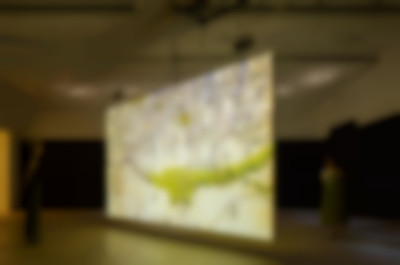

Every Worm Trampled Is a Star explores the possibility of the land’s recovery by listening to its autobiographical voice as it undergoes a process of being returned. The trampled worm stands in for all beings rendered invisible and vulnerable on the land, proposing that beyond the material return of the land lies the possibility of the return of their very existence — a decolonial cosmological return.
For the past 138 years, the ground of the Yongsan military base in Seoul has been cut off from its surrounding communities through histories of colonization and occupation, war and militarized enclosure, demolition and redevelopment. Once a training ground for the Imperial Japanese Army and later a U.S. military base, the site is now in the process of being opened and returned to the public. Across three generations the land’s memory has been displaced and externalized, leaving deep ruptures and disconnection between the land and its community.
The work follows the land’s fragmented, polyphonic voices that includes others like the Nevada desert and the memorial stones along the streets of Itabashi; the architects involved in the reconstruction of the Yongsan base; Zainichi Koreans; and the microorganisms living in the soil. Places both distant and near, landscapes simultaneously microscopic and vast, approach the unseen memory of the soil, revealing the invisible strata of a site long forbidden to Koreans. If the diaspora of people unfolds through regional migration, the diaspora of the land reveals the paradox of a non-moving entity losing its own place. Although the land has never left, it has continually been treated as if it had departed. As the sovereignties, systems, borders, maps, and languages imposed upon it have continually shifted, the land has been reduced to mere value and, over time, has come to erode its sense of self.
The distant landscapes and maps shown in the film evoke a collective loss that had gone unnoticed. The land had long lived only as a metaphor; here, it visits the fragments of its othered memory and re-narrates its history. The maps inscribed upon this land were drawn in the language of possession, exclusion, and occupation. Yet amid rupture, insensible loss, and dispersal, the land erases these maps and reclaims exiled senses. It is the gesture of a land returning to itself, a gesture of recovery.
The narration is voiced by a third-generation Zainichi Korean, a descendant of those forcibly relocated to Japan.