[MICRO-1] Liquid , Condensation
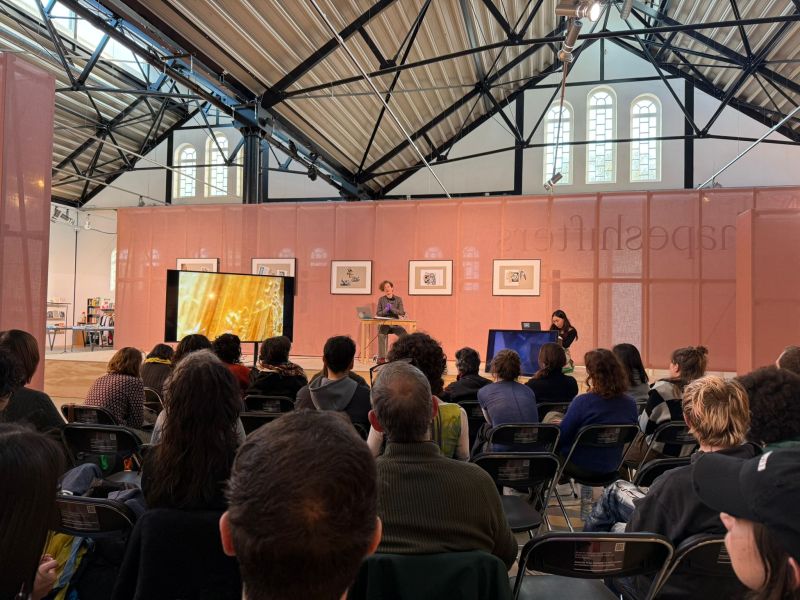
Lotte: For the past years, I have been looking closely at politics of conservation, in and beyond the ethno-colonial museum: I became interested in the invisible residues left by the insecticidal treatments that many European museums applied in collections. How does the museum in the very effort to preserve artefacts, sanitize, repress and control life? What does keeping cultures do to people? Are there ways leading beyond classification, hierarchisation, and objectification?
The more I researched the practices, substances, material histories, and the manner how they affect each other, the more I was struck by how European conservation as a science with its own field of knowledge was complicit in the perpetuation of colonial control over objects that had partly been looted in colonial contexts.
While the restitution debate in the past decade resonated with a promise of returning objects in a perspective of “repair”, that would correct historical wrongs, toxicity seemed a powerful reminder that the forced relation that had been imposed on the world by means of colonialism and post-war modernization programs was here to stay with us - it was “beyond repair” as Annika Haas and Lauren Berlant recall us. The harm was done, the poison was in the soils, in the air, in the water and in our bodies. We would have to think with it, to stay with the trouble, to recognize the unequal exposures that we encountered - and search for ways to challenge and subvert these. The infrastructures of chemical relations that surround and make us largely reside in the realm of the imperceptible (Murphy 2006). We would have to consider our lives as forms of “alterlife”.
[ENDO-2] Objects
Lotte: Aram, you keep tracing leaks, unruly things in the Wereldmuseum Amsterdam—in many senses: humidity that seeps through walls, sound that runs through pipes, air that circulates between closed storages and open galleries…. The museum, like a body, has pores and lets pass humidity, you even think of its climatisation as an organ, a respiratory system. It inhales and exhales with us. The leaks allow us to think about spaces and bodies as porous membranes that breathe, absorb, and exchange. You found plenty of living organisms in the droplets and enlarged them under the microscope. Later you blew them up in 3D and made mobile artefacts of them. They appeared now as microbial bodies that escaped the imperial net, that passed fluidly through the thick walls of this ethno-colonial museum, against all its efforts to keep them sealed. —— Some of them are here with us today. I was drawn with excitement to the way your work unsettles colonial collections and museum conservation, reflecting on the biopolitical and infrastructural control mechanisms imposed on colonized and migrant bodies — while constantly proposing speculative protocols to leak, circumvent, or undermine these technologies.
[MICRO-4] Human skin
Aram: We are here, in this space full of alien murmurs and noises of existence in extinction, to collectively talk about how we can confront our institutional surroundings and question the world. I hope we can unfold some dimensions that are more sensitive than our disconnected nerves. This unfolding should start with whether we can accept someone else’s temperature, humidity, and landscape of memories.
What kind of resonance can I experience if there is a place where my mind is not different from yours, and ‘our’ mind is indistinguishable from ‘their’ mind? I was displaced into this collection to contribute to the flourishing of Western culture. We, as wrapped and labelled curiosities, were brought here to inspire the land that captured us. But we were no more than sensual muses. Collected bodies were flattened — no thicker than a museum’s catalogue, pressing the fragile faces of people and landscapes into a torpor in the wide ruins of extraction.
It is the site for other life, and the site for unwanted beings. Like in a dream, a person used to hold me in her hands and make a sound by sliding my dry body against her. The end of my brown gourd stomach is covered with feathers plucked from the neck of a dead parrot she loved. They function as a memory tool. The collective memory, the land, the ecosystem, and nature’s condition were engraved and recorded in that manner. I speak with the sound of pebbles hitting my insides while the thirteen feathers shake. All these landscapes are scaled and inscribed in me. Our bodies are deeply associated with the lands. Our materiality has been performed only in a particular habitat.
The untouchable entity bears the texture of fingerprints of the last people who used it.
[ENDO-3] Depot
Lotte : “Think of Whiteness as a breaking of some relations between lands and peoples and a making of others, the latter foundationally connected to dispossession.” (Dead White Planet, 58). I see the world through a microscope. The lens prolongs my body, which is never in the picture. I scrutinize the bustling organisms on a glass plate - but did I ever learn that they are part of me? How shall we work in conditions of unequal exposure, when what continues for now to be an uncontested given for some has turned into a laboring act, that has to be achieved against hostile conditions for others?
We connected through a substance: Dichloro-diphenyl-trichloro-ethane, commonly known as DDT : A colorless, tasteless, and almost odorless crystalline compound that both of us encountered in our research. DDT was developed in 1939 by the Swiss Chemical company Geigy AG but conquered the world through the US, as a sanitary agent during the war, in the crowded cities where the industrial workers amassed in small spaces, and as a pesticide massively employed in agriculture after 1945. Its extremely broad use - as insecticide, but also on the bodies of people and objects - occurred at the intersection of the promise of limitless growth, the elimination of hunger, and ultimately, at least in the museum, the end of finitude…. It held the promise of the possibility to keep for eternity, to become more powerful than death, to stop decay and decomposition.
You showed me an archival image of Koreans being sprayed with DDT by the Japanese army under supervision of soldiers from New Zealand at Senzaki in 1946. Here, in the aftermath of war and the nuclear bombs, DDT was applied to extremely vulnerable people whose bodies were inspected with the suspicion of their “harmfulness” - sanitization as domination. “Everything was forever, until it was no more”, you say.
[ENDO-4] Human body tunnels
DDT became a symbol of two countervailing forces that still operate: “The unyielding belief in technology as a marker of modernity” with the compound as an outstanding technological achievement, — and the beginning of an ecological movement that “challenged the prevailing notions of postwar development, highlighting the ecological interconnections between people, nations, and nature” at the other (David Kinkela 7), such as it was voiced since 1962 by Rachel Carson, predicting a Silent Spring.
In modern thought, pesticides have a finality and they are not considered to disrupt a relational system. It took until 1972 before the Environmental Protection Agency in the US banned the domestic use of DDT. But it did not prohibit its exportation or use for public health programs overseas. This asymmetry fully participates in a racial regime of environmental injustice that keeps exposing people and critters along hierarchical division lines. It was only with the UN Stockholm Convention on Persistent Organic Pollutants in 2001, that an international agreement effectively limited the use of DDT - without stopping its effective use and remedying the long term effects.
[MICRO-5] Residue
Aram: DDT operated as a medium for territorial expansion. We, the artifacts, become petrified traces of faraway territories — testifying to societies destroyed by colonial rule and global capitalism. It is an amnesic process. It seems difficult to remove this white crystal from my body. It stays — even in small quantities. By killing life, a new kind of life is generated: toxic life. We are all connected through the poison from the past. The colonial museum breathes through chemical lungs; its air is saturated with residues that continue to live within us. It is a toxic metabolism. A slow circulation of substances meant to preserve inanimate objects, yet producing new forms of unstable life.
Three hundred thousand other entities are contained in this prototype of controlling the time and life of Others. The artificial climate is set to fifty percent relative humidity and a temperature of about twenty to twenty-three degrees Celsius. Once this universal climate is established, the origins of other bodies are forgotten. The practice of preservation is deeply rooted in Western material traditions. Objects are material enactments of decay, their erosion mirrors our forgetting. This hegemonic technology was born from the unease of facing unfamiliar landscapes, people, objects. At the end of the Second World War, millions of people and objects shared a similar experience. For displaced populations, these measures were invasive, humiliating, abusive. Those objects’ prolonged toxicity perpetuates the influence of colonialism far beyond its direct timeline.
[MICRO-7] plants, gourds, feathers, skins
Aram: Objects were at once desired and feared. By killing all potential agents, DDT pacified these beings beyond the material.
Organic bodies are porous; the poison enters and stays. When body and ghosts of objects return to communities, they might be severed from faith, ancestors, time, the living world, turned into timeless toxic monuments. Their bodies are weaponized. Their memories are anesthetized. The canon re-canonizes itself. Life comes from outside and dies inside. I imagine a spectral materialism. I look for beings that leak, deviate, and resist capture, tiny, invisible mediators beyond the institution’s net. Because they evade the human eye, they cannot be fully seized.
So small, so extra-dimensional, they open hyperspaces—paths out of the oppressive material reality.
[ENDO-5] Building Interior, space corner, walls texture& debris
Lotte: Recently, many museums have started to reflect on climate change and how they will react and behave. With the increasing accumulation of artefacts in collections, the question of storage keeps coming back. De-acquisitioning, outsourcing, deep storage in remote places…. Some build passive buildings, with close to no light, few doors, and selfregulated temperature. Many spend huge amounts of energy in order to keep art and artefacts for eternity. In DEEP STORAGE, heritage is sealed up, in a kind of eternal sleep, for a potential reactivation in an uncertain future, often in remote places. It makes me think of these dystopic SF films, in which people are cooled down and sleep for decades, even centuries, before waking up in a world that they no longer recognize. The frozen time in deep storage reminds us that we are bodies in a system, co-evolving, in constant change. I found generative to think with Caitlin deSilvey, a conservation theorist in the UK who wrote Curated Decay. She defends an idea of Heritage Beyond Saving - and explains that decay is part of limited life cycles and that accepting finitude allows for renewal, change, transformation, a movement of constant change and substitution.
In March 2025, the Museum of Brest, in Britany, announced it would close its doors for at least ten years, due to a mold and mushroom deployment, called “infestation” in the language of museum conservation. Mold feeds on the proteins in the paint, and can alter the paint layer irreversibly. “The heart of a museum is the preservation of its collections. And today, we must preserve this collection at all costs,” said the director of the Museum. In less than 24 hours, a proliferating mushroom can expand over a whole museum. It is striking how the imaginary of the “infestation”, “invasion” recalls the protectionism of European countries shielding against migration. ….. In Brest, the museum will be closed for several years. A new storage is built. In order to prevent mold from spreading, temperature and humidity are strictly monitored. Dehumidifiers and fans have been installed in the permanent galleries to stabilize the environment. Later, micro-vacuuming and decontamination step in.
In Danemark, where 18 museums closed for molds, and even at the IFAN museum in Dakar, Senegal, questions are astonishingly not that different. Storages made of concrete - a material that does not breathe - block humidity rather than to let it pass through the pores. Architects like Nzinga Mboub with her office Worofila thinks with the flow of air rather than against it, and works on buildings made of clay, straw, lime….
Materials that are porous, and soaked with what surrounds them. Conservation here is not conceived against the environment but as part of it, breathing with and within. Just as it is practiced by the villagers portrayed in Cecile Mendy’s doctoral dissertation - with plants, winds, clay vessels, - as a transmission of knowledge, embedded in social bonds.
[MICRO-8] Fungal Hyphae & DDT Residue entangled
Aram: If we can remap a new topography of us — outside of the map — I imagine that we, poisoned objects, can become interlocutors for new citizens, celebrating toxic allyships — to discuss the entanglement of past and future. Imagining a different weather could break the rules that shape my body, as if the southern hemisphere always returns. If the sun penetrates the glass ceiling of the museum, will it awaken our poetic intelligence? Can it turn us — frozen and captive things — into a vital force capable of forming other futures? Where should I flow?
In my dream, each of our waves has an autobiographical motion that ebbs outside. When something solid becomes a malleable gesture,
it transcends the physical limits of its territories. This transition metamorphoses my body into liquid waves.
Lotte: How porous are we towards those to whom we are connected at a distance? Those who mine the ore of our devices, and those who die for the world order that allows us to perform. Are we able to bend, to bridge, to relate? To invest intradependence as foundational, not as a metaphor. Your gestures care for the detrimental, residual, messy, or menaced: the living organism beyond control, always connected to the precarity of people’s lives. A reverberation of the intuitive sense that toxic grounds may become fertile for unexpected allyships: troubling matter, liminal media, neither object nor subject; feral agents that run beyond the intended purpose, and hold potentiality nonetheless, or precisely because of their being out-of-joint?
[Micro-9] Human, Object entangled
Aram: I see it as an agitating transformation into a kind of monstrous vermin, bug or insect. I mean…I hope to change into vibrant knowledge.
Then I can become a dynamic verb, instead of an unknown noun. My desires, made up of excluded, oppressed voices, cannot be born while life is suspended. When I travelled, how many other bodies were loaded up, destined for Europe, sanitised in huge ships for centuries? All those gigantic, little bodies had to embrace a new climate, infinitely imposed to remain in eternal stasis.
Yet in this fear, matter begins to remember itself. Against forms of forgetting that locates memory in a solid structure, monopolising the materials eternally. With their modern scientific statements, the museum insisted we be sorted and measured, locked away on heavy pedestals. Everything operates silently by the self-consciousness of the building. The Pedestal publishes the order of the world. We are too poisoned to return. Yet our toxicity has become a material memory, binding the past to our contaminated present. We breathe with these residues. Though our bodies are touched unequally, to start with this poison is where our connection begins.
[ENDO-8] Object
Lotte: I seldom touch artefacts myself, I seldom touch anything; as a theorist in a knowledge system that separates experience and analysis, I watch others touch, and am held accountable for my take on these situations only in an abstract manner, I am constantly invited to speak about, not among, with, close by, as part of….Very much in accordance to this distanced relation, I encountered In the past years manyfold devices of protection, – protecting objects from people (snow white cotton gloves, marks on the ground, signs on the wall, ropes, showcases, sound alarms…) - and reversely, people from objects (nitrile gloves in bright colors, and FFP 3 masks, sometimes full body suits, and respiratory devices…) There was this conservator in Leipzig, who showed me how the process of cleaning and sensing an object would be disrupted, now that she is systematically using nitrile gloves after she was told that the direct contact may expose her to poisonous residues.
There is the artist who activates instruments from colonial collections, but who has to protect his lips when blowing in a pipe. Does a toxic flute contaminate the sound it makes? Does it still sound? Toxicity fundamentally shifts the way to relate. There are communities who preferred bequeathing their now-dead, formerly spirit laden artefacts in the museums that poisoned them, leaving the responsibility with the institutions. There are plenty of untold stories about conservators who died from cancers in young ages - rumors circulate, everybody knows, but an epistemic barrier obstructs to go beyond technical adjustments and rethink what it means to “keep a culture” on the threshold of life and death. Chemical modernity comes back as a boomerang.
[MICRO-11] Metal Plate
Aram: I stand with a metal plate pressed against my chest. Breathe in.
Hold.
my country was still on the list of those considered at risk for tuberculosis. People of all origins wait together in a room. One begins to perceive oneself, And others, as bodies under scrutiny, present only to establish whether we can be labelled healthy and stay, or diagnosed as ill, and have to leave. I stand with the metal plate against my body and hold my breath……….until I am given permission to breathe again.
[ENDO-10] soil passage
Lotte: The promise of modernity was built on the aspiration of the elimination of all forms of life considered detrimental to an exclusively human project of growth - accelerated by capitalism. But a body - human or not - is never a rigidly enclosed, protected entity, “It is vulnerable to the substances and flows of its environments, which may include industrial environments and their socio/economic forces.” (Alaimo, Bodily Natures, 28) Breath requires “co-habition, co-respiration, con-spiring” writes Tim Choy (Dead Planet, 98). Nature is as close as one’s own skin. Our bodies are made possible and are limited by what Elizabeth Grosz describes as the “precarious, accidental, contingent, expedient, striving, dynamic status of life in a messy, complicated, resistant, brute world of materiality” (quoted in Alaimo, 10).
Several of your works, Aram, and particularly your film X-Hale, deliberately create alliances with relatives-in-becoming, humans, microbes, insects, molds, and other life forms - often in troubling and unsettling ways….
[MICRO-12] – Pores
Aram: I collected the condensation of exiles —in the Museum. I let the images of microbes from the waterdrops, the exile of the institution, perform inside my body. It created an intimate contact. It allowed me to relate to them in my flesh —to hold them in my body, I aim to go beyond the binary conception of human and non-human. There is no clear distinction between what is object and what is not-object.
Inside and outside are constantly articulated by inhalation and exhalation. I was intrigued by the resonance between the words exhale and exile. You are asked to hold your breath until the process is complete. Then you can exhale. They let you go.
[MICRO-13] – Pores (breathing Soil)
Aram: When something solid becomes a gesture, it transcends its territory.
Lotte : X-ray, a medical and military technology, has served as both a technology of control for dominant classes, and leverage for environmental justice claims for people and workers in precarious conditions. In your use of X-ray images, your body is shown as vulnerable and “over-exposed” by technology and patriarchy - but also as a powerful agent, a smuggler of multiple life forms ! As if confirming the suspicion of the public health authorities, living cultures travel with you without permission. Imagery produced within a hygienist perspective with a biopolitical goal turn here into a locus for radical relational co-constitution with others, investing contamination as a site of intrarelating, at your and their existential risk. The images blur the distinction between a healthy and an ill body, they leave us in an oscillating uncertainty, in the company of the many that compose us….
Aram: Beyond the map, imagine another topography —one that welcomes new alliances….